


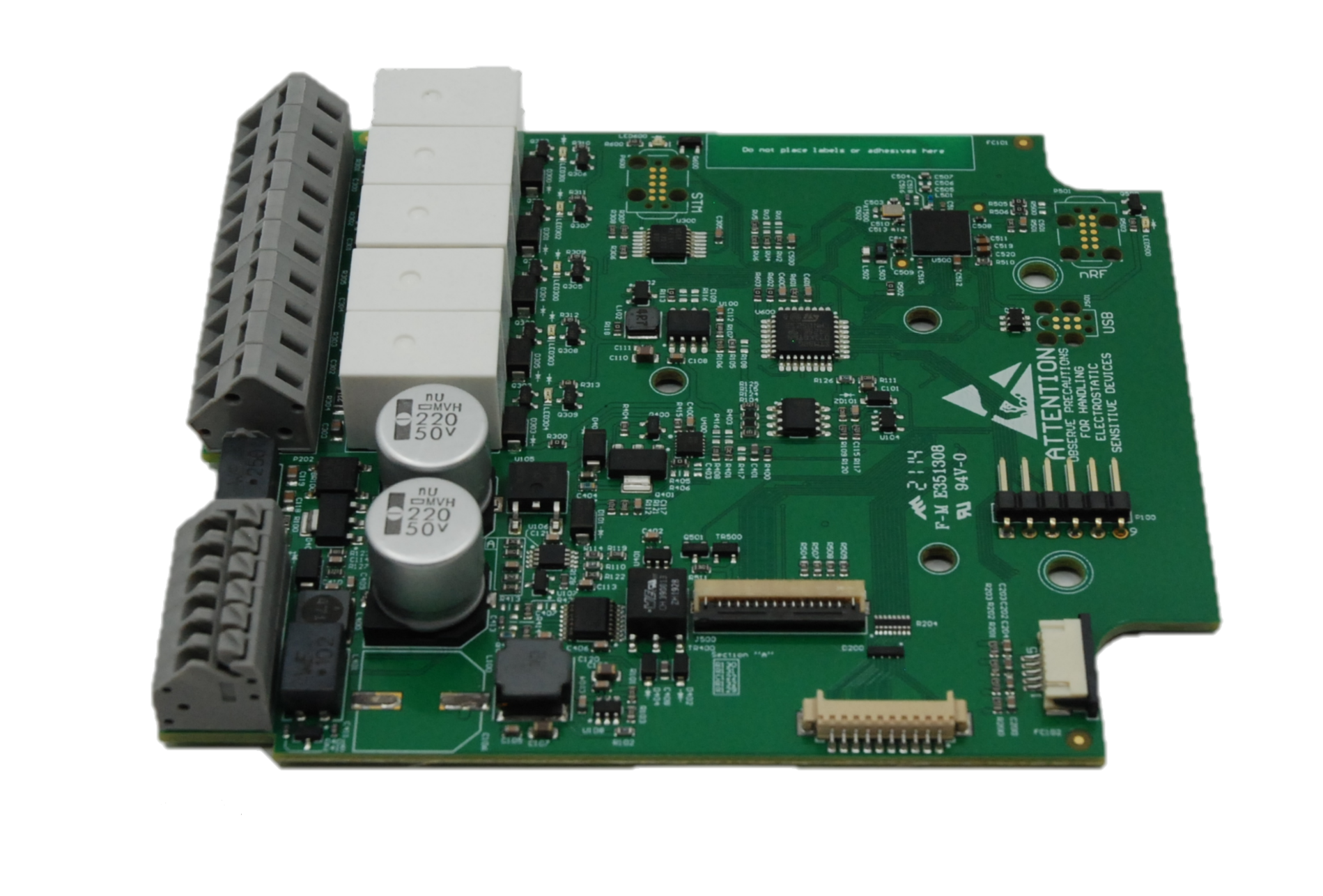

At Zign, our experience in both development and manufacturing has shown us how important it is to consider production requirements early in the design process. Considering how a board will be built and tested at this stage helps avoid costly changes and time-consuming redesigns later, once the layout and design have been finalised.
So what makes a PCB design ready for manufacturing? Several examples from our work show how board architecture, assembly and production testing can influence the answer.
In one of our projects, the customer highlighted that power connectors on devices used in their working environment were prone to damage during everyday use. We placed the power-connector section on a separate PCB, allowing it to be replaced while retaining the main electronics.
This added an extra board and interconnection to the assembly, but made servicing more straightforward and cost-efficient. Replacing only the affected section reduces repair costs and electronic waste. It shows how experience from the intended use environment can inform board architecture, balancing assembly requirements with ease of maintenance over the product’s lifetime.
In another project, we developed a central processing board that needed to connect to several separate electronic units, each with its own PCBA. The board combined a number of wired and wireless interfaces for communication with these units.
Because we were responsible for the whole system, we defined the interfaces between the boards before starting the individual board layouts: connector types, pin assignments, cable routing and how each unit would be programmed and tested.
Considering these connections as early as possible in the development process is crucial for aligning the individual board designs with the wider system. It also makes it easier to define how the complete system will be tested, rather than testing each board individually.
For Triple Solar’s Pika heat pump controller, we developed the electronics and embedded software platform, including separate input/output boards for connecting sensors and actuators. As part of the industrialisation process, we also developed a Functional Circuit Tester (FCT) to program and test the PCBA, designed to integrate seamlessly into the manufacturing line.
The tester combines programming and functional testing, allowing boards to be checked consistently against defined requirements.
Considering the test setup during development helps determine which connections need to be accessible and where they can be placed. Test equipment can also be developed around an existing board, but considering both together provides more flexibility to adapt the layout, which in turn can reduce the cost of the FCT and make testing easier during production.
The examples above show how decisions about a board’s design affect the work needed to assemble, test and maintain the product. A replaceable connector board, interfaces defined across a whole system, and a tester developed alongside the PCBA: each of these started as a design decision and ended up shaping how the product is built, tested and serviced.
There is no single solution that suits every design, but considering these practical requirements early gives more room to weigh the options. For us at Zign, that is the value of connecting development and manufacturing: understanding what a design choice will mean when the product is built and used.

